| Elixir Ensemble at Marysburg Assumption Church, Nov. 2011 |
![]() |
| Mezzo-soprano Cassandra Warner |
| Elixir Ensemble at Marysburg Assumption Church, Nov. 2011 |
![]() |
| Mezzo-soprano Cassandra Warner |
The Humboldt and District SPCA is going to “Raise the Woof.”
That’s the name the association chose for its campaign to raise money for a new animal shelter.
At the HDSPCA, they do what they can with the space that they have. Right now the small building located on Hwy. 5 east houses 10 dogs and 28 cats. Ask any one of the workers, and they will tell you the shelter is already full
to capacity, yet they anticipate an intake of more animals when the really cold weather hits.
“At least they’re safe here with us,” said Susan McInnes, a board member of the SPCA and a regular volunteer. McInnes was busy cleaning out the cats’ cages in one corner of
the shelter, while another volunteer was just coming back from walking one of the dogs.
McInnes took the tiniest black kitten out of a small cage and held it up in her hands.
“We may have someone for this little one,” she said. “I’m hoping that they will come back for her.”
The SPCA is offering a special deal for kittens right now, as a means to try and lower the number of animals in their facility.
“Some of the older ones have been with us far too long,” McInnes said about the cats at the shelter, “but people generally tend to want the little ones.”
Meows, purring, and various displays of character and personality came from the furry felines, who all seemed to crave a little affection, or a sniff of the hand, or just a little caress. One young cat up in the second floor cages looked quite comical as she tried to make herself noticed by clinging with all four paws to the wire of the cage.
“It would be a wonderful thing if some of these animals could even be fostered out before Christmas,” McInnes said. “We’re usually short on staff at that time of the year, and it’s really difficult to get enough volunteers.”
The problem the shelter faces now won’t be solved with a new building – because there will always be animals abandoned or turned in – but the new space will have amenities that aren’t available in the current space. The plans include an off-leash area for the dogs, and a park-like area where people can donate a memorial tree or a memorial bench.
HDSPCA vice-president Bonnie Hepp says everyone on the board, as well as the many volunteers, are excited about the proposed new space for the animal shelter. Sketches of the proposed project will be on display at the trade show, November 6 and 7 at the Uniplex in Humboldt.
“We will have a display that will show our current facilities, plus the drawings for the new one, plus pictures of many of the animals that have come through our shelter over the years,” said Hepp.
So far, the SPCA has raised $106,000 toward the new facility, and they are just about to launch their “Raise the Woof” campaign for the additional $500- to $600,000 that will be needed for the land, building and equipment required to run the shelter.
The new facility will be approximately 4,000 square feet and will be located in the industrial area on the west side of Humboldt.
And they do it all for the love of little critters.
It will be a leap of faith for Rachel Lees this fall when she goes from Humboldt to Lausanne, Switzerland.
Lees will be the only Canadian attending a disciple training session with the international organization, Youth With a Mission (YWAM), for three months. Twenty-five young Christians from different countries around the world will spend five months together during the training and the two-month overseas mission.
“I’ve never travelled outside of North America,” said Lees. “I’ve never even been on a plane before. It would really be a big disappointment to me if I chickened out!”
With a father who is a pastor, Lees has been brought up as a Christian in the Alliance Church. Already at age 20 she has integrated faith into her life.
After her Grade 12 graduation from Humboldt Collegiate Institute, she went on to attend the Nipawin Bible College for two years. Part of those studies included going on a mission each year.
The first year, she went and stayed in the poorest area of Regina, working with street kids through the Healing Hearts Church.
The second year the college sent her to work with Union Gospel Mission in Vancouver, B.C., in the city’s Downtown Eastside, a drug-infested area with an equally high rate of prostitution. Both experiences have made a mark on Lees, who hopes to continue in this kind of work in the future.
“It was a real eye-opener as to how close we all are to that kind of life,” she said. “We met women who were highly educated, but who for some reason ended up on the street in prostitution.”
Lees said the trip gave her a heart she didn’t know she had, and she found out through God’s direction that she could actually do things for these people.
After bible school and the two missions, Lees turned her thoughts toward getting an education in an area where she would be able to find work and support herself. She was interested in studying graphic design, and had heard that YWAM offers university courses complementary to its Christian purpose. Her application was accepted, but she found out later that it wasn’t for the graphic design course.
Ironically, there was some confusion with the program choice, and instead of graphic art, she had been accepted for the disciple training and mission.
“I thought ‘that’s perfect’!” said Lees.
Lees is open to the idea of going to any country for the mission.
“I’m up for any place that needs us,” she said, and explained that the group will decide together, through prayer, where they will go for their mission from a list of possibilities made available by YWAM.
“It will be really cool to see what everybody is passionate about,” she added.
What happens at the end of five months?
“I’ll have to come back to Canada, because of my student visa,” Lees said. “I really don’t know what will happen after that.”
Lees knows that all kinds of opportunities for missionary work exist in Canada, in fact right here in Saskatchewan. One of the options she considers a possibility would be returning to Regina, where they have youth shelters and soup kitchens.
So much could change for a young Canadian in five months abroad.
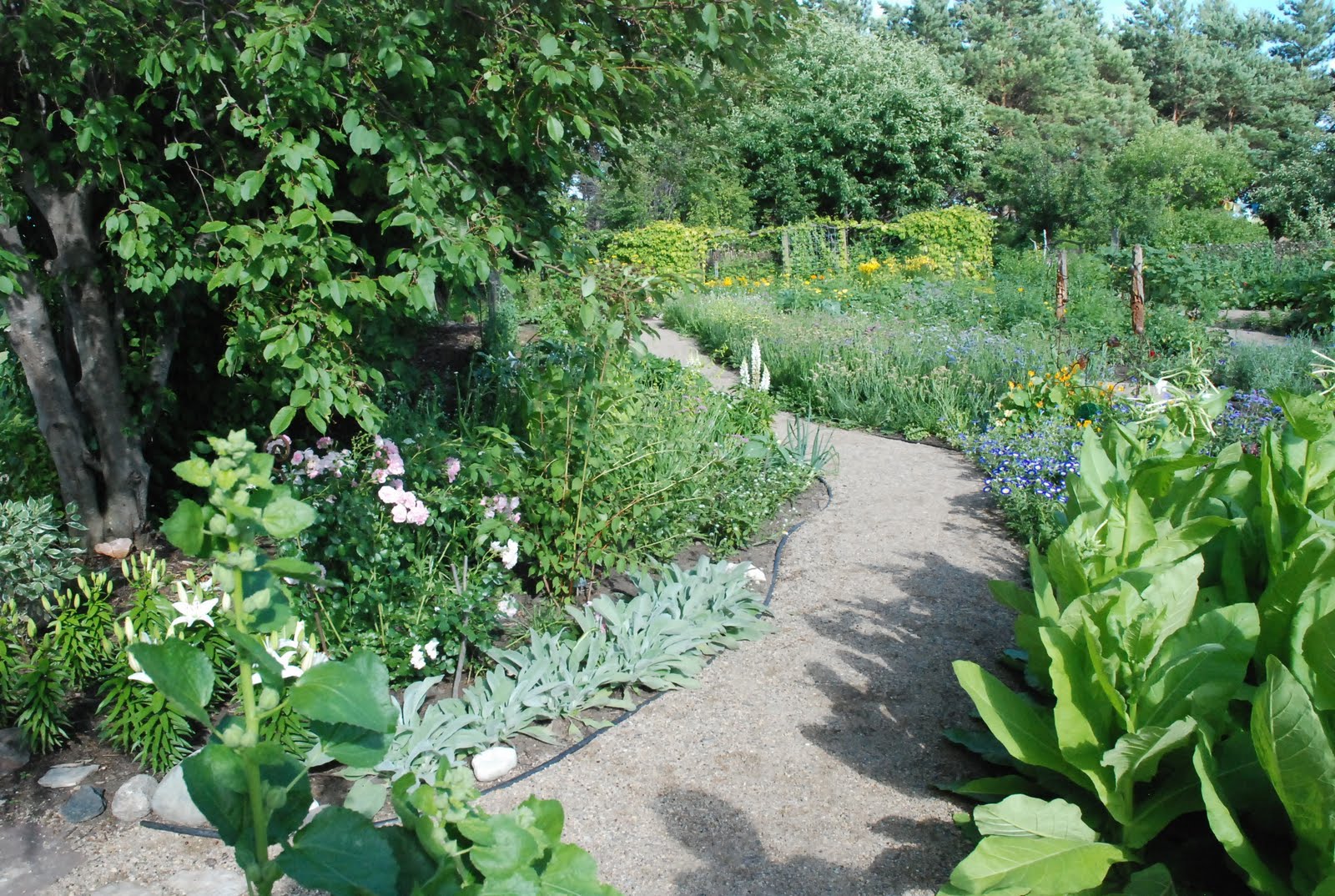
When you follow Marie Saretsky around her garden, she effuses with enthusiasm as she talks about the 20-year dream that finally came to life this year.
Marie and husband Jerry Saretsky live on a 14-acre farm just outside of Burr. Until this year, she used the plot of land, now been transformed into a meditative garden with curving pathways and lush vegetation, to grow flowers for her dried flower business, Flowers of Dellwood Creek, www.dellwoodcreek.com.
Prior to that, it was a wheat field.
“We broke the soil 29 years ago,” said the pixie-like woman, “the year my son was born.” That was when her long journey began, the journey that led her to discover the direction her garden was meant to grow.
Saretsky has always been interested in gardening, and making use of what the land offers. From her dried flowers, she has created a myriad of small crafts, such as floral arrangements, homemade paper with pressed flowers, handmade cards, herbal sachets; the list goes on.
But over time, her vision changed, and she became interested in something she refers to as intuitive gardening.
“It can be many things, a garden,” explained Saretsky, “There’s the language of the flowers, and there’s the historical symbolism that goes with flowers. When I give garden tours, there is no end to the topics you can have in a garden.”
Or, she added, you can just walk quietly through it and enjoy.
To see the garden today, it’s hard to believe that in the spring the pathways weren’t yet laid down.
At that point, according to Saretsky, she didn’t know whether the garden was really going to go ahead. Then she had some volunteer help through the WWOOF organization (World Wide Opportunities on Organic Farms); a couple of “Woofers” came from France and completely pruned the lilac hedge that borders one long wall of the garden. That is when Saretsky started to believe it was going to happen.
A short time later, another two girls who had seen her ‘blurb’ on the WWOOF website came from the United States to help. Together they got the paths put in. But it was a case of “three steps forward and two steps back”, for when the rains came in the spring, she was left with a garden full of weeds.
Today, bright blue delphiniums stand nearly six feet tall near the north “wall” of her garden, while the east wall is covered with yellow lilies.
“The garden has four walls,” she explained, “for the four directions. The east wall isn’t finished yet, but when it is done, there will be a mass of yellow in the middle of the lattice work. It symbolizes the rising sun, which is the new beginnings of a new day.”
Plants of all kinds line the curving paths, which, Saretsky insisted, are meant to slow people down as they wander through the garden.
“Walking through a garden should be relaxing.” she said.
Leggy garlic stems sway above Lady’s Mantle, while a row of tomato plants stand proudly next to a clump of sunflowers, three feet high. Further along the pathway, onions border the edge in front of a row of calendula.

“It’s a mixed garden, with both vegetables and flowers, the way we use to garden,” noted Saretsky. “Today there is a trend toward monocultures, but it didn’t used to be like that.”
At the centre of her garden, on a little stone patio, a wooden table and chairs invite the visitor to sit down and contemplate. The quirky effect of the brightly painted furniture, each item a different colour, adds to the garden’s charm.
Saretsky loves the idea of sharing her garden and can think of many ways people could come and enjoy the space. It could be a place of inspiration for artists, a place of quiet meditation for yogis, a place for people to commune with nature or a place for those who want to learn more about intuitive gardening.
It will be the first time local artist Karen Holden has exhibited at the Hand Wave Gallery in Meacham.

Located in the small village west of Humboldt, the gallery features solo and group exhibitions of Saskatchewan artists and artisans from May through December.
“For the Love of Critters,” the title of Holden’s current exhibit, is a collection of pastel drawings and sculptures that represent her unique affinity with animals.
It is rare to find someone who befriends a porcupine, plays hide and seek with muskoxen, or enjoys the company of a fox when working in the garden of the farm she shares with husband and artist, Mel Bolen.
That’s why all the “critters” in her show have names – because she has a story for all of them. The personality of each animal comes through in her renditions: their eyes and their facial expressions have almost a human quality to them.
“I cannot imagine living without animals in my life,” reads the beginning of the artist’s mission statement, “There is a great deal to be learned from nature’s creatures.”
Holden chose to work with pastels for the small, almost pocket-sized renditions. The advantage of using this medium is the delicate blending of colours that can be achieved, set off by the darker shades of paper the artist used to draw on.
Holden also does sculpture and has included some pieces in this exhibit.
At the entrance to their property is an example of one she completed recently, a muskox made entirely of lengths of rope tied onto a wire frame. Its horns, nose and hooves are made of clay. The inspiration came from the herd of ten muskoxen they brought to their farm, animals the University of Saskatchewan were looking to find a home for.

But there is room on their farm, a vast acreage west of Humboldt near Carmel. Thirty years ago, they bought an abandoned church and the land around it; now it is the fruit of their labour, love and vision in making it an artist’s paradise.
“It exemplifies how we live as artists, and what we do,” Holden said of her home, which they open to the public on Mother’s Day every year for a gathering of any and all who are interested in coming.
The main floor of the renovated church is Bolen’s atelier, and with a two-storey high ceiling that allows plenty of light in, it’s the perfect place for an artist to work.
The quiet and solitude of the winter months is when the couple get most of their work done, Holden said, because they tend to get a lot of company in the summer. And they travel as well, recently back from one of their regular pilgrimages to Europe where their main occupation is visiting as many exhibits as they can possibly squeeze into each day.
Holden has her own studio in a converted barn on their property. Built under the eaves of the building, the large, open floor plan painted white lets in the maximum amount of light. Here she is beginning the foundation work for her next project of landscape paintings. The large, six by ten foot canvases will be based on sketches and drawings she will be doing in Orange, France, a trip she is about to embark on with six other artist friends.
“Working on these large canvases is a little intimidating,” admitted Holden, “but it brings with it a sense of freedom as well.”
The same sense of freedom she wishes for all her critters.

Spandex shorts glistened under the morning sun, mosquito repellent was being tucked away into carry bags, and cups of steaming hot coffee were being filled for the 40 cyclists about to start the Great Annual Saskatchewan Pedal (GASP).
At 7:30 a.m. Sunday, July 17, when most people are still padding around home in their pyjamas; a group of avid cyclists were getting ready to set off from Humboldt on a six-day cycling trip around the east central part of the province.
But not before they were treated to a Saskatchewan-themed hearty breakfast prepared by chef Jenni Willems, and organized by Local Bounty, a group that aims to connect Saskatchewan chefs with local food producers.
Willems was busy dishing out her farmer’s sausage scramble, along with a hunk of whole wheat flax bannock, and a dish of haskap granola breakfast sundae to each of the hungry cyclists. All of the dishes, she explained, were made with ingredients grown by local food producers.
Men and women of all ages, shapes and sizes were gearing up for the long ride ahead of them. For some, the daily average of 100 km would be a challenge; for others it would be just a short jaunt, said Bob Cochran, the GASP tour representative. Cochran has been cycling in it himself since the year 2000.
In all, the six-day tour covers 600 km. Organizers have dubbed this year’s tour the ‘Golden Ocean’ for the vast fields of canola and mustard along the rural routes.
Some of the cyclists have travelled from as far away as Ontario, Alberta and British Columbia to take part in the tour.

This is the third time Harry Atkinson, of Sidney, B.C., has done the trip. Atkinson comes to Saskatchewan to do the GASP because he enjoys it, but also because this is where his roots are.
“I love having the opportunity to come back here, and I keep giving myself the challenge to do another year,” said the hearty 71-year old.
Dennis Findlay, originally from Semans and now living in Toronto, just finished another week-long cycling tour in Ontario, the Great Waterfront Trail Adventure.
The tour ended back in Humboldt on Saturday, July 23.
.